
Industry News
Curation by industry experts
Hot Articles
Popular Tags
Designing Packaging System Flexibility for Frequent SKU Changeovers
Designing Packaging System Flexibility for Frequent SKU Changeovers
Frequent SKU changeovers can turn a high-speed packaging line into a bottleneck when format adjustments, cleaning, and restart checks consume valuable production time. A machine may handle every planned pack size and still perform poorly on a mixed production schedule. The problem is often what happens between runs: missing change parts, incomplete settings, slow quality release, or downstream equipment that cannot follow the new format.
Designing packaging system flexibility means balancing throughput, hygiene, and repeatable changeover performance—not simply specifying faster machines. The useful question is whether the complete line can move between defined products and packaging formats, then return to stable production without excessive waste or operator intervention. That capability needs to be designed, tested, and maintained.
Define the transitions, not just the SKU count
A list of SKUs is a starting point, but it does not describe changeover difficulty. Changing printed film while retaining pouch dimensions is different from switching pouch width, dosing method, product viscosity, and allergen profile together. Likewise, changing a bottle label may leave the filling process untouched, while changing closure geometry can affect handling, capping, inspection, and rejection.
Build a transition matrix around the actual production schedule. Group products into families with common pack geometry, product-contact components, cleaning requirements, and operating windows. Then identify frequent transitions and infrequent but demanding ones. A direction matters: moving from an allergen-containing product to one without that allergen may require controls that do not apply in the reverse sequence.
For each priority transition, the user requirement specification should define:
- The starting and finishing product, packaging material, and format.
- Required mechanical adjustments, change parts, cleaning, and line-clearance tasks.
- The available crew, their expected skill level, and any permitted external preparation.
- The conditions for restart approval and sustained acceptable output.
- The expected transition frequency and its effect on the production plan.
Separate confirmed requirements from possible future formats. Otherwise, projects can accumulate expensive “flexibility” features for products that may never launch, while overlooking a routine transition that will happen every shift.
Measure from the last good pack to stable production
Changeover claims are difficult to compare unless everyone uses the same boundary. Mechanical setup time alone excludes cleaning, material clearance, thermal stabilization, quality checks, and startup rejects. Define the main measure as the interval from the last accepted pack of the outgoing SKU to sustained acceptable production of the incoming SKU. Specify what “sustained” means for the project, including output rate and quality criteria.
Also record the components of that interval. A single total cannot show whether the constraint is a difficult forming-tube replacement, a sanitation hold, or repeated seal adjustments. Keep planned changeover work distinct from faults discovered during restart, but retain both in the production-loss assessment.
For capacity planning, compare a representative schedule rather than nameplate speeds. Saleable output depends on productive running time, sustained rate, and accepted yield. A faster machine may contribute less usable capacity if it takes longer to change formats or produces more startup waste. The result must be calculated using the site's SKU mix and operating assumptions, not a generic percentage improvement.
Make mechanical changeovers repeatable before automating them
Tool-less adjustments help when they eliminate searching, fastening, and alignment work. They do not automatically guarantee repeatability. A quick-release guide that an operator positions by eye can still generate jams after every change. Positive stops, indexed scales, locating features, and clearly identified format kits are often more useful than an impressive collection of quick-release handles.
Inspect how change parts are handled outside the machine. Heavy assemblies need safe removal and transport. Product-contact parts need protected storage after cleaning. Similar-looking components should be distinguishable at the point of use. Captive fasteners can reduce loose-part risks, while incorrect-fit prevention can reduce assembly mistakes.
The practical objective is to move preparation outside the stopped-line window where safe and feasible. Incoming materials, approved format kits, and required documentation can be staged before shutdown. Tasks requiring isolation, access to moving equipment, or controlled hygienic conditions must remain within the appropriate safety procedure.
A changeover map should show the distinction: external preparation, shutdown and clearance, cleaning, mechanical setup, recipe confirmation, and restart approval. It should also show which tasks can run in parallel without creating safety or contamination risks.
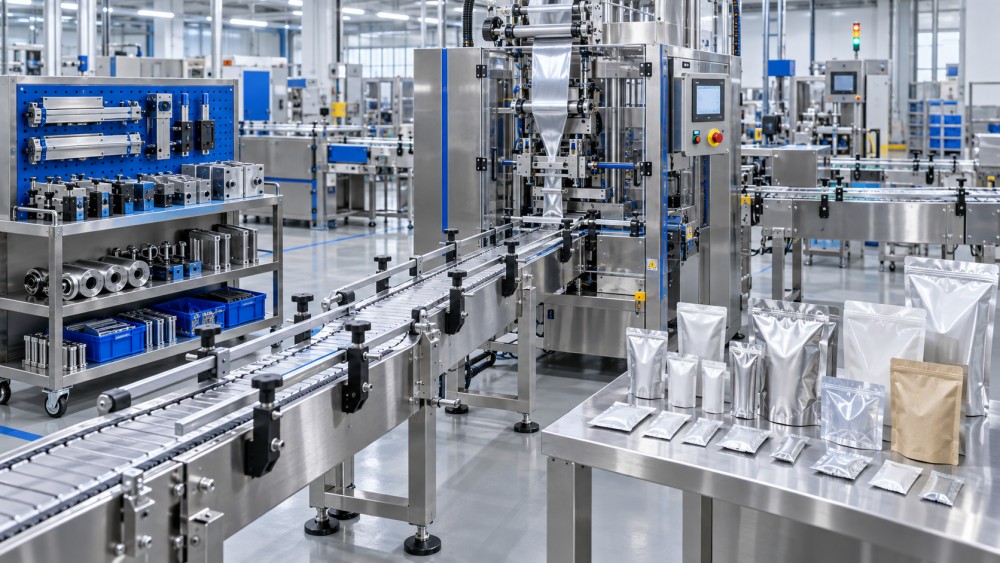
Servo positioning is worth considering for frequent, repeatable adjustments across many axes. For occasional changes, a well-designed manual mechanism may be simpler to maintain. Compare both against positioning accuracy, access, fault recovery, washdown exposure, and lifecycle support—not automation level alone.
Treat hygiene and package integrity as design limits
Mechanical versatility is not the same as process compatibility. A filler capable of handling several container sizes may not accommodate both a low-viscosity beverage and a particulate product without different valves, nozzles, or product-path arrangements. A pouch machine's dimensional range says little about its ability to seal different material structures reliably.
For food applications, assess whether removable components remain drainable, accessible, and cleanable. Quick connections should not introduce residue traps or assembly errors. Where clean-in-place is used, changing the product path may affect flow distribution and cleaning coverage; the relevant configurations need assessment and validation.
Aseptic systems impose additional constraints. A format intervention that breaches a controlled sterile boundary may require a defined re-sterilization and release sequence. Faster hardware replacement cannot bypass that sequence. In meat and dairy applications, sanitation, temperature control, and allergen management can dominate the transition even when packaging adjustments are straightforward.
Packaging-material changes need their own process checks. Film thickness, stiffness, friction, barrier structure, and sealant behavior can affect tracking, forming, sealing, and leak performance. Establish operating windows using representative materials and products. Supplier specifications are necessary inputs, but they do not replace trials on the intended equipment.
Connect recipes across the whole line
Recipe management reduces manual entry only when a recipe covers the relevant equipment and is controlled properly. A filler can load the correct settings while the checkweigher retains the previous limits, the printer uses old artwork, or the case packer follows the wrong count. The line may run, but the output is not necessarily releasable.
Define a line-level SKU identity and map it to approved machine recipes, inspection settings, coding information, and packaging materials. Include version control, authorization for changes, and a record of what was loaded. Where technically feasible, use material verification and equipment-state checks to prevent an incompatible combination from starting.
Not every setting can be downloaded. Manual guide positions, installed tooling, and physical material identity still require confirmation. The interface should distinguish commanded settings from verified conditions rather than displaying a reassuring “recipe loaded” message that conceals unfinished work.
Line coordination also includes accumulation and product handling. Conveyor guides, transfers, rejection devices, cartoners, and palletizing patterns must follow the new format. Buffer capacity should be evaluated for each relevant pack geometry; a conveyor length that handles one format comfortably may provide little protection for another.
Test the difficult combinations before acceptance
Acceptance testing should demonstrate transitions, not merely separate successful runs. Include a frequent change, a demanding format change, and a cleaning-sensitive transition where relevant. Test small and large packs, but also examine combinations near process limits: a wide pouch with difficult film behavior may reveal more than width alone.
Factory acceptance testing can establish mechanical and control performance under agreed conditions. Site acceptance must account for actual utilities, upstream supply, downstream interfaces, sanitation arrangements, and production staffing. If substitute materials are used at the factory, document which conclusions remain provisional.
Agree on evidence before testing begins: elapsed changeover time, crew size, interventions, rejected product, material waste, and quality results. Depending on the package, checks may include fill accuracy, seal integrity, closure application, code readability, or atmosphere measurements. Methods and limits should come from the applicable product requirements and validated procedures.
Repeatability matters more than one carefully rehearsed demonstration. Include the expected operators where possible, record deviations, and verify the updated instructions after corrections. A transition that works only with a supplier specialist present has not yet demonstrated routine operational flexibility.
Choose the right boundary for flexibility
One highly adaptable line is not always the right answer. If product families require incompatible hygienic conditions, widely different dosing technologies, or lengthy validated cleaning cycles, dedicated modules or separate lines may be more practical. Compare capital cost against scheduled downtime, waste, maintenance complexity, spare tooling, and the consequences of a single shared asset failing.
The Global Advanced Food & Packaging Systems (AFPS) examines these trade-offs through its coverage of aseptic filling, dairy fluid processing, meat processing, baking equipment, and high-speed flexible packaging. Its Strategic Intelligence Center connects process and packaging perspectives—a useful approach when a proposed packaging change also affects upstream product behavior or hygienic controls. Sector intelligence can sharpen project questions, but equipment trials and site-specific validation remain essential.
Before approving a design, review the transition matrix with production, engineering, quality, sanitation, and maintenance. Identify the slowest credible change, confirm who owns each release decision, and check whether the planned schedule still works under those conditions. Packaging system flexibility is demonstrated when ordinary crews can repeatedly produce acceptable packs across the agreed SKU range—not when every format appears in a brochure.
Recommended News