
Industry News
Curation by industry experts
Hot Articles
Popular Tags
Packaging Upgrades: Balancing Strength, Line Speed, and Shelf Appeal
Packaging Upgrades: Balancing Strength, Line Speed, and Shelf Appeal
A stronger package is not a successful upgrade if it slows production or weakens shelf impact. Upgrading packaging for strength, efficiency & shelf appeal means assessing material performance, machine compatibility, and visual presentation as one interconnected system. In food and beverage manufacturing, changes to film thickness, barrier structures, or seal design can affect product protection, achievable line speed, and hygiene requirements.
The difficult decisions usually sit between departments. Purchasing wants a lower material cost. Operations wants fewer stops. Quality needs defensible protection through shelf life. Marketing wants a pack that stands upright and looks distinctive. A useful evaluation makes those trade-offs visible before a new structure reaches routine production—not after the first damaged pallet or extended sealing adjustment.
Define the failure before choosing the material
“We need stronger packaging” is not a specification. A chilled meat pouch punctured by a sharp product edge has a different problem from a snack bag splitting along its seal during distribution. Increasing film thickness might help one failure and leave the other untouched.
Start with rejected packs, complaint photographs, line-stop records, and samples recovered from distribution. Identify where failure begins: the film body, a fold, a seal intersection, a zipper attachment, or a contact point inside the case. Also establish when it appears. Damage immediately after filling suggests a different mechanism from leakage that emerges after freezing, vibration, or repeated handling.
Translate the findings into acceptance criteria. For a liquid pouch, those might include leak resistance after a defined drop sequence and no seal failures under specified handling conditions. For a stand-up bag, they may include puncture resistance, filled-pack stability, and reliable zipper opening. Keep the product, fill weight, conditioning temperature, and test method consistent when comparing candidates.
Do not assume the retail pack is always the right place to add strength. If damage concentrates at pallet edges, a case divider or revised pallet pattern may solve the problem without changing the primary package. That distinction can avoid unnecessary material cost and machine requalification.
Separate mechanical strength from product protection
A package can survive a drop and still provide inadequate shelf-life protection. Tensile strength, tear propagation, puncture resistance, oxygen barrier, and moisture barrier describe different properties. They should not be collapsed into a single “premium film” claim.
For nuts or fat-rich snacks, oxygen exposure may be a major quality concern. For crisp bakery products, moisture ingress can undermine texture. Chilled meat applications require assessment of package integrity alongside the intended atmosphere and cold chain. Barrier requirements must come from the product’s deterioration mechanisms and validated shelf-life expectations, not from the highest number available on a supplier’s brochure.
Compare oxygen and water-vapor transmission values only when their test conditions are compatible. Temperature and humidity matter; an attractive laboratory result does not automatically represent performance in a humid warehouse. Film data also do not establish whole-pack performance where seals, closures, or handling damage create another path for ingress.
This is particularly relevant when replacing a laminate with a structure designed for easier recycling. A mono-material approach may be suitable, but equivalent gauge does not guarantee equivalent stiffness, barrier, or sealing behavior. Recyclability claims also need confirmation against the intended market’s collection and processing arrangements. Treat the change as an engineering project, not merely a substrate substitution.
The seal window often decides whether the upgrade is practical
On a high-speed pouch line, a material’s usable sealing window is often more valuable than its best seal-strength result. The question is whether acceptable seals can be produced across realistic variations in temperature, pressure, dwell time, and product contamination.
Consider a powder pouch. Dust reaching the seal area can interrupt bonding even when the film performs well in a clean laboratory test. A liquid application creates another challenge: splash or product residue may affect the interface. Better filling control or seal-area management can sometimes deliver more reliability than moving to a heavier structure.
Hot tack deserves attention where the seal is loaded before it has fully cooled. A seal that develops adequate strength later may still open as the fresh pack drops, accelerates, or transfers to a conveyor. Conversely, excessive heat can distort the pack, damage printing, or narrow the operating window.
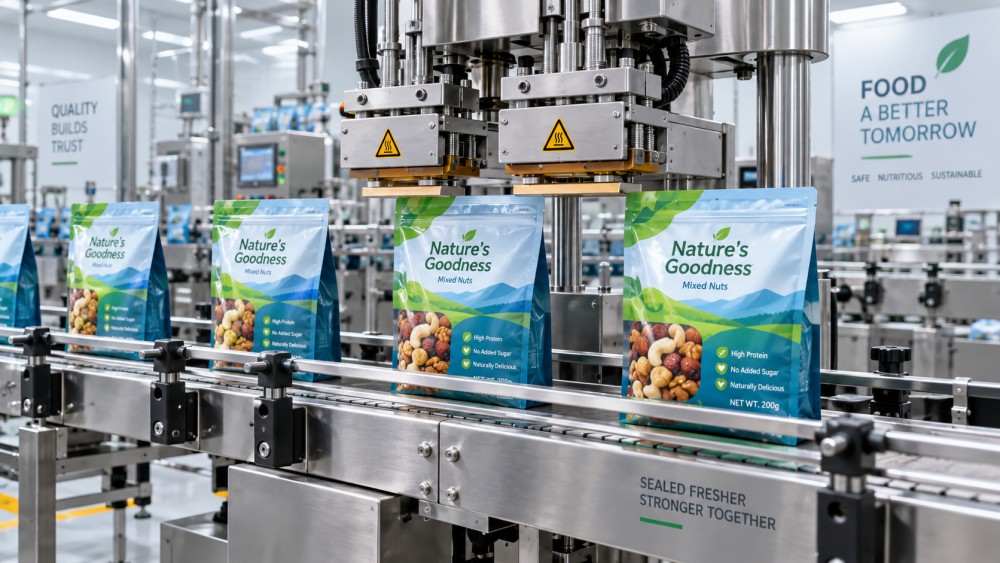
Ask suppliers to distinguish cooled seal strength from hot-tack performance and explain the conditions used for each measurement. During trials, pair strength testing with an appropriate leak-detection method. A strong sampled seal does not prove the absence of channels elsewhere in the package.
Ultrasonic sealing may be worth evaluating for some structures and contamination conditions, but it is not a universal replacement for thermal sealing. Material compatibility, tooling, seal geometry, and actual product behavior still determine suitability. The same caution applies to claims that a new sealant will run faster: demonstrate that advantage on the intended equipment.
Measure saleable output, not the fastest machine setting
A short run at maximum speed proves surprisingly little. Packaging efficiency is the number of acceptable packs produced over a meaningful operating period, including startup waste, stops, rejected packs, and changeovers.
A stiffer film may improve pouch presentation but require forming adjustments. A different coefficient of friction may change web tracking or finished-pack behavior on conveyors. Premade pouches may feed differently because of curl, blocking, zipper thickness, or dimensional variation. These effects can appear intermittently rather than during the first few minutes of a demonstration.
The trial should follow the pack beyond the filler. Check coding, inspection, checkweighing, case packing, and pallet handling. A pouch that runs through the sealing station but repeatedly tips before the case packer has not improved line performance.
Changeover effort also belongs in the comparison. Record whether the candidate needs different jaws, forming parts, recipes, cleaning access, or operator adjustments. A material that performs well on a long campaign may be less attractive for a plant running many short batches.
Build the trial around operating variation
- Run the current package as a baseline with the same product and comparable machine conditions.
- Include startup, normal production, a controlled stop and restart, and an agreed range of operating speeds.
- Sample packs across the run, rather than selecting only visually perfect examples.
- Record stop causes, scrap, seal settings, inspection rejects, and downstream handling issues.
- Where practical, assess multiple material lots before concluding that the process is repeatable.
Agree on pass criteria before testing. Otherwise, teams can end up accepting a candidate because the defects look manageable, without calculating what those defects mean over a production week.
Shelf appeal must survive filling and distribution
An empty printed sample is not a reliable representation of the retail package. Fill weight changes panel tension. Gas flushing changes shape. Vacuum packaging changes how graphics sit against the product. Chilling can introduce condensation that affects visibility and handling.
Evaluate filled samples in their intended orientation and under representative retail lighting. Look for panel distortion, weak standing stability, scuffing, and graphic elements lost in folds. A matte finish may suit the design but still needs suitable abrasion resistance. A clear window may improve product visibility while introducing a barrier or light-protection trade-off.
Opening performance is part of presentation, too. A tear notch should initiate a controlled opening without compromising transport durability. A zipper needs to remain accessible after filling and sealing. Consumers encounter these details before they form an opinion about the product itself.
Check printed information on finished packs, including date codes and barcodes where applicable. Registration, contrast, curvature, and surface finish can affect readability. Do not approve artwork independently of the physical pack if forming or sealing will alter its position.
Keep hygiene and process compatibility as approval gates
For aseptic beverages, packaging changes can affect sterilant exposure, material resistance, sealing, and the validated sterile boundary. For dairy and other sensitive products, a packaging upgrade cannot compensate for inadequate upstream processing or sanitation. Shelf life belongs to the complete product-process-package system.
This system-level view connects the equipment fields covered by Global Advanced Food & Packaging Systems (AFPS): aseptic filling, dairy processing, meat processing, bakery production, and high-speed flexible packaging. The practical value of connecting those disciplines is recognizing dependencies—for example, how fill temperature or product residue changes packaging performance.
Require food-contact documentation appropriate to the destination market and intended use, including relevant temperature and contact conditions. Where inks, adhesives, or multilayer structures change, assess the applicable migration and compatibility requirements. Existing approval for one application should not be assumed to cover another.
Choose the option with the widest reliable operating margin
Compare total cost per saleable pack, not material price alone. Include material consumption, scrap, downtime, tooling, changeover labor, and secondary-packaging changes. Keep safety and shelf-life requirements as pass-or-fail gates; a weighted score should not allow attractive graphics or lower cost to cancel an unacceptable leak risk.
The preferred option is rarely the strongest film or the fastest trial result in isolation. It is the package that meets protection requirements while tolerating routine production variation and retaining its intended appearance. Before release, freeze the agreed material specification, machine settings, inspection methods, and supplier change-notification requirements. Those controls help keep a successful trial from becoming an unstable production process.
Recommended News