
Industry News
Curation by industry experts
Hot Articles
Popular Tags
How Do You Calculate ROI on Commercial Baking Equipment?
The return on commercial baking equipment depends on the additional cash it generates compared with keeping the current production setup—not on its rated capacity or purchase price alone. A faster oven can deliver a poor return if proofing, cooling, packaging, or customer demand prevents the bakery from selling its extra output.
A defensible calculation combines the full installed investment with measurable operating savings and contribution from additional sales. Calculate ROI over a stated period, report payback separately, and test whether the investment still works when utilization, margins, or commissioning performance fall below expectations.
Define what the investment is being compared against
Before calculating returns, establish the alternative. Is the bakery replacing an unreliable oven, adding capacity, automating loading and unloading, or moving production from several batch ovens into a continuous line? Each decision creates a different financial baseline.
For a replacement, compare the new equipment with the realistic cost of continuing to operate the existing machine, including necessary repairs. For an expansion, compare it with operating without the extra capacity—or with another feasible way of meeting demand, such as overtime or outsourced production.
Do not assume that “no investment” means “no cost.” An aging oven may require a major burner overhaul, while continued overtime may be needed to fulfill existing orders. However, include those avoided costs only when they are supported by maintenance assessments or production plans.
Use operating records covering a representative production cycle. The baseline should capture product mix, saleable output, staffing hours, energy use, rejects, maintenance expenditure, and downtime. A peak-season week is not a reliable substitute for a full-year forecast.
Use ROI and payback for different questions
For a straightforward, undiscounted cash-based calculation:
ROI over the evaluation period (%) = [(Cumulative incremental net operating cash flow + End-of-period recoveries − Initial investment) ÷ Initial investment] × 100
Incremental net operating cash flow means additional cash revenue less additional cash operating costs, plus verified savings relative to the baseline. End-of-period recoveries can include equipment resale proceeds and released working capital, where justified.
For a project generating reasonably stable annual benefits:
Simple payback period = Initial investment ÷ Annual incremental net operating cash flow
Payback answers how long it takes to recover the initial outlay. ROI answers how much net return accumulates over a defined period. Neither calculation, by itself, recognizes the time value of money.
Dividing annual cash benefit by investment produces an annual cash return ratio, not the same measure as cumulative project ROI after recovering the original outlay. Label the metric clearly: a “40% return” is ambiguous without its time horizon and calculation method.
Build the investment figure from the installed cost
A supplier quotation is only part of the investment. The relevant number is the cash required to make the equipment operational and support the resulting production.
Deduct proceeds from selling the existing equipment if those proceeds are credible. Treat recoverable VAT or similar taxes according to their actual cash timing rather than automatically classifying them as a permanent investment cost.
Imported equipment adds currency and service considerations. Model exchange-rate exposure on unpaid balances, overseas technician travel, and essential spare-parts inventory where applicable. A lower quoted price may not produce a lower installed cost.
For downtime, use lost contribution rather than lost revenue: production that does not occur also avoids some variable costs. If orders can be produced in advance or transferred elsewhere, calculate the actual mitigation expense instead.
Convert technical improvements into cash benefits
Additional output is valuable only when it can be sold
Start with sustainable saleable output, not maximum nameplate throughput. For a continuous line, rated production must be adjusted for scheduled operating hours, stops, changeovers, speed losses, and rejects. Avoid applying separate utilization discounts that already include the same losses.
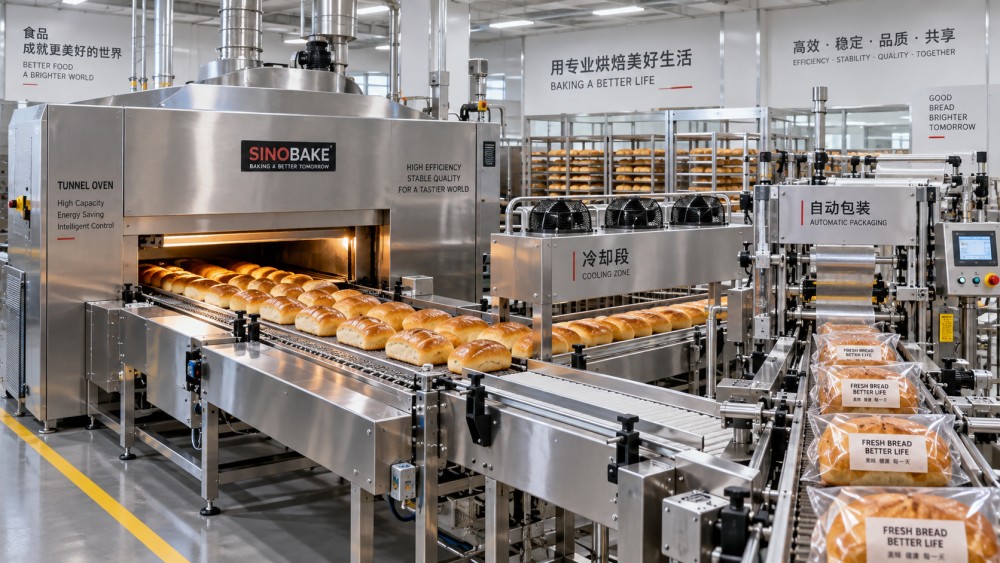
The oven may not determine total line capacity. Mixer availability, dough resting time, proofing capacity, cooling residence time, slicing, and packaging can limit output. Increasing baking speed without expanding the actual bottleneck may create work-in-process rather than additional sales.
A useful financial relationship is:
Additional contribution = Additional units sold × Contribution margin per unit
Contribution margin is net selling price less the costs that vary with those sales, such as ingredients, packaging, incremental distribution, and production-related variable expenses. Use realistic net prices after discounts, returns, and customer allowances.
Forecast additional units sold as the lower of achievable extra output and supportable additional demand. Producing 300,000 more rolls does not justify a revenue benefit if customers are expected to buy only 120,000.
Labor savings require an actual change in cash expenditure
Automated loading or unloading can reduce handling time, but fewer minutes per batch do not automatically reduce payroll. Cash savings arise when the change eliminates overtime, agency labor, a paid position, or an otherwise necessary new hire.
If employees remain on the payroll and are reassigned, quantify the output or external expense that reassignment improves. Do not count both the full labor saving and additional production benefits from the same released hours without explaining how both occur.
Include employer contributions and other avoidable employment costs, but retain expenses that will continue after installation. Allow for supervision, sanitation, setup, and maintenance work introduced by the new system.
Measure energy per saleable unit under comparable conditions
Installed power is not energy consumption. Compare electricity and fuel required to deliver equivalent saleable products, accounting for warm-up, idle operation, exhaust, steam generation, and load level.
A larger oven can use less energy per kilogram at a suitable load while consuming more energy overall. Evaluate the expected operating schedule and product mix, not just a full-load demonstration. Different loaf weights, moisture targets, and bake profiles can materially change consumption.
Calculate energy costs consistently: either include all modeled energy changes as a separate benefit or incorporate the variable portion in contribution margins. Counting it in both places inflates the return.
Quality and reliability need identifiable financial effects
Improved temperature uniformity may reduce underbaked products, excessive bake loss, or color-related rejects. Value those improvements through avoided material and processing costs or extra saleable contribution, depending on what changes operationally.
Do not value every recovered unit at its selling price. If recovered products replace existing production rather than create additional sales, the benefit is the avoided production cost.
Reliability benefits also need boundaries. Reduced breakdowns can avoid emergency repairs, overtime, or outsourcing. Additional sales from recovered operating hours belong in the output calculation and should not appear again as a separate downtime benefit.
Subtract additional maintenance, service contracts, software charges, consumables, sanitation expenses, and recurring training. Automation may reduce manual handling while introducing controls, sensors, or conveyor components requiring specialist support.
A worked example: replacing a commercial oven
The following figures are hypothetical and illustrate the calculation method, not equipment prices or industry benchmarks. Assume the replacement supports existing production and a modest, demand-backed increase in sales.
The additional-sales contribution is calculated without duplicating the energy and reject benefits shown separately. Assume benefits start immediately, remain constant for five years, and exclude financing, income tax, resale value, and working-capital recovery.
Simple payback = $180,000 ÷ $70,000 = approximately 2.57 years.
Five-year ROI = [($70,000 × 5 − $180,000) ÷ $180,000] × 100 = approximately 94.4%.
The annual cash return ratio is 38.9%, but that is not the five-year ROI. The first-year cash benefit also does not recover the full investment.
If commissioning takes several months or sales grow gradually, use a monthly cash-flow schedule. Payback occurs when cumulative net cash flow turns positive; dividing investment by the eventual steady-state benefit would understate the recovery time.
Test the assumptions that could change the decision
The most useful sensitivity test changes the variables that drive the project's benefits. For the example above, holding investment constant produces these illustrative outcomes:
A downside scenario should reflect a plausible operating condition, such as lower sales, retained staffing, a delayed startup, or reduced energy savings. Simply cutting every benefit by an arbitrary percentage can hide the reason the investment becomes weak.
There is also a useful approval threshold. To recover $180,000 within three years under a constant-benefit assumption, the project needs at least $60,000 in annual net cash benefits. If independently supported savings cover only $45,000, the remaining $15,000 must come from credible additional sales or another identifiable benefit.
Use discounted cash flow when comparing longer-lived assets
Simple ROI treats a dollar received in year five as equal to a dollar received today. For equipment with a multiyear operating life, net present value provides a stronger comparison:
NPV = −Initial investment + Σ [Incremental net cash flow in year t ÷ (1 + discount rate)t]
Include terminal proceeds and working-capital recovery in the appropriate year. With the example's $70,000 received at each year-end for five years and an illustrative 10% discount rate, NPV is approximately $85,400. That rate is a calculation assumption, not a universal benchmark.
Match the discount rate to the cash-flow basis. An unlevered project appraisal should not subtract loan repayments from operating cash flow; an equity appraisal incorporates financing flows and uses an appropriate equity return requirement. Depreciation is not a cash operating expense, although it affects taxes in an after-tax model.
When comparing equipment with different useful lives, use a common evaluation horizon with justified residual values, or an equivalent annual cost approach. Comparing three-year ROI for one machine with seven-year ROI for another is not meaningful.
Make performance evidence part of the calculation
The question of how to calculate ROI on commercial baking equipment investment ultimately rests on whether projected benefits can be demonstrated. Request performance evidence using the intended recipes, product dimensions, loading patterns, and quality tolerances. Define acceptance criteria for saleable throughput, energy consumption, changeover time, and staffing requirements.
Separate verified savings from benefits dependent on sales growth or organizational changes. A purchase supported by measurable cost reductions has a different risk profile from one justified mainly by uncommitted future orders.
The strongest investment case is not the one with the highest quoted capacity or shortest optimistic payback. It is the one whose installed cost, operational constraints, and cash benefits remain credible under the conditions in which the bakery will actually operate.
Recommended News