
Industry News
Curation by industry experts
Hot Articles
Popular Tags
What Maintenance Schedule Does Commercial Bakery Equipment Need?
A commercial bakery maintenance schedule should combine daily cleaning and operating checks, weekly inspections, periodic technical servicing, and manufacturer-specified work based on operating hours. A mixer running several shifts needs a different service interval from one used occasionally; an oven with stable temperatures may still need scheduled combustion, airflow, and safety-system checks.
When an oven shuts down during a bake or a mixer begins struggling with normal dough loads, the disruption reaches beyond lost production. Product consistency, delivery schedules, and food safety can all suffer. What maintenance schedule does commercial bakery equipment require to prevent these problems? Start with the equipment manual, then adjust the planning frequency for workload, flour dust, moisture, heat, and recorded wear—not simply for the date on the calendar.
A practical starting schedule
The following framework helps organize preventive maintenance. It is not a substitute for machine-specific instructions: lubrication intervals, inspection methods, replacement limits, and service responsibilities vary by model. Use the manufacturer’s interval or any applicable required inspection interval whenever it is more restrictive.
Calendar-based inspections and operating-hour tasks should coexist. A weekly condition check does not replace a gearbox service due at a specified number of hours, and an annual service does not justify postponing a damaged guard or overheating bearing.
Daily work: catch deterioration before the next batch
Before startup, examine the machine while it is safely stopped. Look for loose or missing parts, damaged cables, leaks, worn seals, and residue left from cleaning. Check that removable components are correctly seated and that guards are in place. Test interlocks and emergency stops only through the approved procedure; never bypass them to keep production moving.
Once operation begins, compare performance with normal conditions. An oven taking longer to recover temperature, a mixer producing a new knocking sound, or a conveyor drifting toward one side deserves a recorded observation. Operators should not reach through guards or attempt adjustments on moving machinery.
After production, clean according to the equipment’s sanitation instructions and the bakery’s food safety plan. Remove dough and baked-on residue without damaging coatings, seals, or sensors. Do not assume that every machine can tolerate hose-down cleaning: water entering motors, bearings, control panels, or insulation can create faults that appear later.
- Food-contact components: dismantle only approved parts, clean and sanitize as required, and inspect for cracks or damage.
- Flour accumulation: use an approved method and equipment suitable for the dust hazard; avoid blowing flour into airborne clouds with compressed air.
- Reassembly: confirm that tools, fasteners, and cleaning materials have been removed before release.
Cleaning frequency may also be triggered by allergen changeovers, contamination events, or product residue—not just the end of the shift. Sanitation and mechanical maintenance need separate records, even when performed during the same stoppage.
Match the maintenance task to the machine
Ovens: track heat delivery, not just the display
Daily oven checks should cover door seals, visible chamber condition, abnormal odors, and heat-up behavior. Where accessible and permitted, remove crumbs and deposits after the oven has cooled sufficiently. Restricted airflow and damaged seals can affect baking even when the controller shows the expected setpoint.
Schedule periodic inspection of circulation fans, exhaust paths, steam systems, conveyor drives, and temperature sensors. Verify temperature performance with suitable calibrated instruments and the manufacturer’s test method. Comparing a display with an unsuitable handheld thermometer does not establish accuracy throughout the baking chamber.
Gas-fired equipment also needs qualified inspection of burners, ignition, flame supervision, and associated safety controls at the prescribed intervals. Combustion adjustments and gas-train work are not operator tasks. On tunnel ovens, include belt condition, tracking, tension, and zone performance; a temperature problem may originate in airflow or belt loading rather than the sensor.
Mixers: separate cleaning from drivetrain servicing
Clean bowls, tools, and approved removable parts after use or at the required sanitation interval. Inspect attachment seating, bowl retention, guards, and visible wear before starting another batch. Unusual vibration, oil near the mixing area, or a change in mixing time at the same recipe and load should trigger investigation.
Belts, gears, bearings, and bowl-lift mechanisms need checks according to the manual. Some bearings are sealed and require no routine lubrication; some gearboxes have specific lubricant and change requirements. Adding grease indiscriminately can damage seals or introduce contamination. Use the specified lubricant and quantity, including food-grade suitability where incidental food contact is possible.
Proofers and retarder-proofers: manage moisture and refrigeration
Inspect door gaskets, drainage, condensate, and humidity behavior. Clean water reservoirs and humidification components according to the prescribed method, and check for scale where water quality makes buildup likely. Persistent standing water or an unexplained odor calls for investigation rather than a higher humidity setting.
Periodic work should include fans, sensors, water connections, and accessible refrigeration heat exchangers where fitted. Temperature drift can result from dirty coils, damaged seals, sensor problems, or refrigeration faults. Refrigerant work requires appropriately qualified personnel.
Dividers, sheeters, and conveyors: watch wear that reaches the product
Inspect scrapers, rollers, belts, cutting parts, and product-contact surfaces for damage and trapped dough. Belt fraying, cracked surfaces, and loose fragments are both reliability and contamination concerns. Follow the approved cleaning process rather than using improvised sharp tools that score surfaces.
Check tracking and tension against the manufacturer’s method. Excess tension can overload bearings; insufficient tension may cause slipping. Lubrication points near open product require particular control, and many belt surfaces must remain free of oil or grease.
Use planned downtime for checks operators cannot safely perform
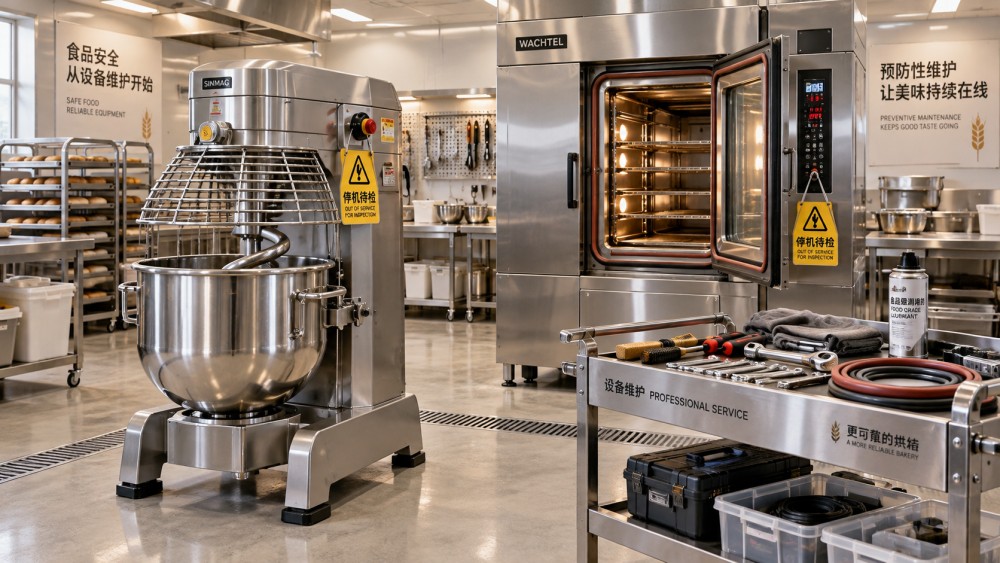
A weekly maintenance window is useful for inspecting components hidden during normal production. Isolate equipment, apply the site’s lockout/tagout procedure, and verify control of electrical, pneumatic, thermal, gravity, and other stored energy before opening guards or starting work. An emergency stop is not an energy-isolation device.
During this window, examine approved access areas for loose fasteners, drive wear, lubricant leakage, damaged hoses, and residue buildup. Inspect filters and ventilation openings, replacing or cleaning them according to the manual. Record findings even when no repair is needed so deterioration can be compared over time.
Monthly or hour-based technical checks can go further: assess bearing condition, drive alignment, pneumatic leaks, sensor performance, and control faults. Electrical cabinet inspection and connection checks belong to qualified personnel using suitable isolation and test procedures. Do not tighten electrical connections indiscriminately; follow specified torque and inspection requirements.
Longer service windows should group compatible tasks to avoid repeated dismantling. Arrange parts, access equipment, and qualified technicians beforehand. Replacement of belts, seals, or bearings should follow specified intervals or condition limits, not an assumption that every component needs annual replacement.
Adjust intervals when workload or conditions change
A schedule built around one shift can become inadequate when production expands. Track operating hours, batches, starts, or cycles according to the component’s service requirement. A machine used intermittently may still need calendar-based inspections because seals, corrosion, and lubrication condition can deteriorate during inactivity.
- Create an asset record. Capture the model, serial number, manual revision, service history, and specified maintenance intervals.
- Identify production-critical equipment. Consider the effect of failure, available backup capacity, repair lead time, and food safety consequences.
- Assign each task a trigger. Use calendar time, operating hours, cycles, measured condition, or an event such as a repair.
- Review repeated findings. Shorten inspection intervals when wear appears between planned checks, while investigating the underlying cause.
Dusty conditions, frequent wet cleaning, heavy dough loads, and repeated heating and cooling can justify closer monitoring. Do not automatically extend a manufacturer’s service interval because recent checks looked satisfactory. Any extension needs a defensible technical basis and must remain compatible with safety requirements and warranty conditions.
Symptoms that should override the calendar
Preventive maintenance does not mean waiting for the next appointment when a fault develops. Stop and isolate equipment when there is a credible safety or contamination risk, including a failed guard or interlock, smoke, electrical arcing, a suspected gas leak, or loose material that could enter food. Follow the site’s emergency procedure where applicable.
Other symptoms call for prompt assessment: rising motor temperature, repeated overload trips, worsening vibration, temperature instability, persistent conveyor misalignment, or changing product weights from a divider. Record the recipe, load, settings, and operating conditions when the symptom appears. This helps distinguish equipment deterioration from process variation.
Repeatedly resetting a trip or increasing a temperature setting can hide the cause. A slow bake might reflect restricted airflow or a failed heater; a struggling mixer might be overloaded or have drivetrain wear. Diagnosis should precede adjustment, especially where protective controls are involved.
Close each job with evidence that the machine is ready
A useful maintenance record identifies the asset, date, operating hours, task, technician, findings, parts used, and next due trigger. Record measured values where they matter, together with the instrument or method used. “Checked oven” gives the next technician little help; a documented temperature verification or seal defect provides a usable reference.
After maintenance, account for tools and removed parts, restore guards, and clean or sanitize affected areas as required. Verify safety functions through the approved procedure, then run an appropriate operational test. Repairs affecting heat delivery, mixing, portioning, or conveying may also require a controlled product check before normal production resumes.
Keep unresolved defects visible, with an owner and a decision on whether operation is permitted. When the same fault returns, review alignment, loading, cleaning practices, installation conditions, and component suitability rather than simply replacing the part again. That review turns the maintenance schedule into a working reliability plan instead of a completed calendar.
Recommended News