
Industry News
Curation by industry experts
Hot Articles
Popular Tags
Meat Marination Processes: What Improves Yield Without Texture Loss?
In modern meat plants, meat marination processes must do more than boost flavor—they need to improve yield, protect texture, and support stable, high-throughput production. For operators and processing teams, the real challenge is balancing brine pickup, retention, tumbling intensity, and temperature control without creating softness or purge loss. This article explores the key process factors that help achieve higher efficiency and consistent product quality.
When higher yield is the priority, the process must be judged by retention—not pickup alone
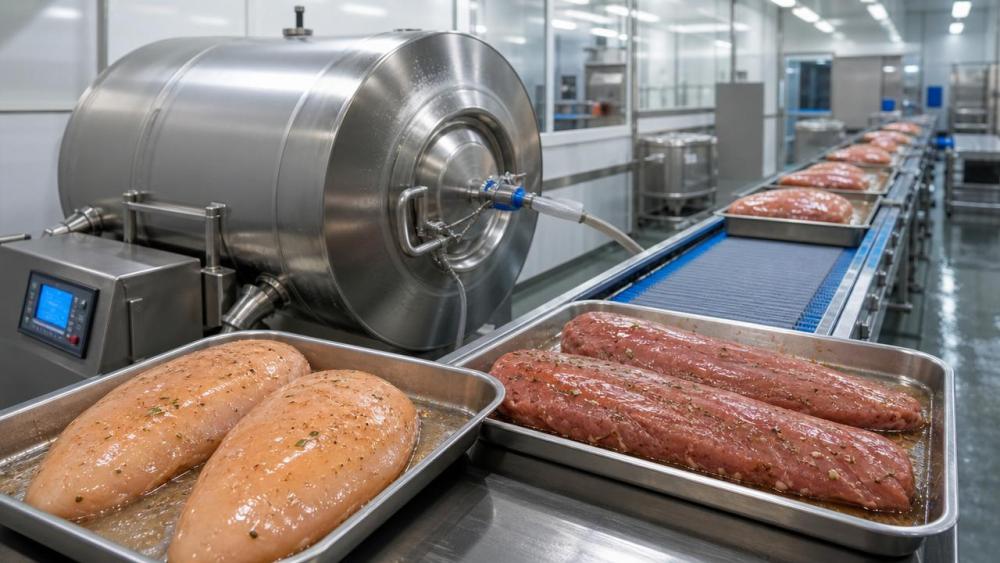
Many meat marination processes appear successful at the injection or tumbler stage because the product gains weight quickly. However, true process performance is defined by what remains after distribution, storage, cooking, slicing, and reheating. In practical terms, a plant can report strong brine pickup and still lose value through purge in packs, texture breakdown, or cooking loss. That is why yield should always be evaluated as a chain: pickup, protein extraction, binding, retention, and final eating quality.
This matters across the broader food processing industry AFPS observes, where efficiency must align with hygiene, consistency, and throughput. In meat deep processing, the best meat marination processes create a stable internal water-protein matrix instead of simply forcing more moisture into the muscle. If the structure is damaged by over-injection, excess mechanical action, or warm handling conditions, the product may look efficient on paper but perform poorly at the next stage.
Different production scenarios demand different meat marination processes
Not all marinated products respond the same way to salt, phosphates, vacuum tumbling, or dwell time. A chilled whole-muscle chicken fillet for retail trays is a very different scenario from cooked ham for slicing, marinated beef strips for ready meals, or frozen pork portions for foodservice. The correct process window depends on muscle type, cut geometry, target shelf life, cook profile, and packaging format.
In high-speed plants, scenario-based judgment is essential because line balance influences product quality. If upstream injection is aggressive but downstream chilling, massaging, and packing are not synchronized, the brine system may not stabilize before packaging. As a result, even technically sound meat marination processes can fail due to poor sequence control rather than poor formulation.
Scenario 1: Fresh retail cuts need moderate pickup and clean bite
For fresh poultry breasts, pork loins, and similar retail cuts, the target is usually moderate yield improvement with a natural appearance and firm bite. In this scenario, meat marination processes should focus on even injection distribution, light to medium vacuum tumbling, and strict low-temperature control. Excessive mechanical action can open the surface, create smear, and produce visible purge in the tray.
The key judgment point is whether the product still resembles intact muscle after marination. If fibers separate too much or surfaces become glossy and pasty, the process has likely gone beyond the ideal extraction range. For fresh retail products, less aggressive protein extraction often protects texture better than chasing maximum pickup.
Scenario 2: Cooked and sliced products need stronger binding and thermal stability
Ham-style products, deli meats, and restructured whole-muscle items depend on stronger protein activation. Here, meat marination processes can use longer vacuum tumbling cycles, controlled rest time, and tighter formulation management to improve sliceability and cooked yield. The objective is not just water retention in raw form but water retention after heat treatment.
The main risk in this scenario is surface overworking combined with underdeveloped internal distribution. A product may become sticky outside while still showing weak internal binding after cooking. Better results often come from staged processing: injection, short equalization, structured tumbling under vacuum, and a defined maturation window before forming or cooking.
Scenario 3: Ready-meal meat components must survive reheating without dryness
Meat strips, cubes, or portions used in chilled or frozen prepared meals face a different challenge. They may be cooked, frozen, transported, and reheated by the end user. Effective meat marination processes for this application should prioritize multi-stage moisture retention, because loss can occur during cooking, freezing, thawing, and final regeneration.
A common judgment point is whether the product remains juicy after the second heat cycle. In these applications, moderate pickup with strong retention usually performs better than high pickup with weak binding. Cut size uniformity also matters: inconsistent geometry causes uneven marinade distribution and variable final texture in the tray or pouch.
Scenario 4: Foodservice bulk packs need process robustness more than peak pickup
Large-format marinated meat for bulk packs often moves through long logistics chains and variable storage conditions. In this case, robust meat marination processes should resist purge, mechanical damage, and handling stress. A stable process with slightly lower pickup may outperform a more aggressive process that looks better at the tumbler discharge point but breaks down later in bags or cartons.
The practical focus here is repeatability. Brine viscosity, needle pressure, vacuum level, batch loading ratio, and product temperature must remain tightly controlled. Small deviations become expensive when multiplied across large-volume runs.
What changes between scenarios: key differences in process requirements
Which process settings usually improve yield without texture loss
Across most applications, successful meat marination processes share the same discipline: controlled pickup, adequate equilibration, limited structural damage, and continuous cold-chain management. The following settings usually deliver better yield while protecting bite and appearance:
- Keep raw material temperature consistently low before injection, during tumbling, and before packing. Warm meat loses structural control quickly.
- Use injection patterns matched to muscle thickness. Over-pressurizing thin areas often creates local pockets and purge.
- Treat vacuum tumbling as a protein development step, not a universal intensity tool. More revolutions do not always mean better retention.
- Allow enough post-marination equalization time for brine migration and stabilization, especially in whole-muscle systems.
- Measure success with final yield, cook loss, purge level, and texture score together rather than pickup alone.
In advanced operations, process data also becomes part of quality control. Tracking vacuum level, drum occupancy, cycle time, product temperature, and retained weight after defined hold periods makes meat marination processes more predictable. This is where modern processing machinery adds value: not only through capacity, but through repeatable control over variables that directly affect yield and texture.
How to match meat marination processes to product goals
- If visual naturalness is critical: reduce mechanical severity, keep pickup moderate, and prioritize uniform distribution over maximum absorption.
- If cooked slicing performance matters most: build a staged process with stronger vacuum action, controlled extraction, and adequate maturation before cooking.
- If freeze-thaw or reheat stability is required: test retention over the full lifecycle, not just after raw marination.
- If throughput is the main constraint: validate that faster batch turnover does not shorten equalization time below the retention threshold.
- If batch variation is high: tighten incoming raw material sorting by pH, size, fat level, and muscle type before changing the marinade system.
Common misjudgments that weaken yield or damage texture
One frequent mistake in meat marination processes is assuming that low texture quality always comes from formulation. In reality, mechanical overload, raw material variability, and poor temperature discipline often play a larger role. Another common error is evaluating marination immediately after tumbling instead of after overnight holding, cooking, or retail display. Early-stage appearance can hide later purge or softness.
Plants also sometimes overcorrect when yield targets are missed. Increasing injection rate or tumbling time may lift short-term pickup but worsen the final result. A better response is to identify where the loss happens: during post-tumble drainage, thermal processing, slicing, freezing, or package storage. Once that loss point is visible, meat marination processes can be adjusted with much greater precision.
The next practical step is to test by scenario, not by theory
The most effective route to higher performance is to build small, scenario-specific validation trials. Compare at least two process windows for the same product: one focused on higher pickup and one focused on higher retention stability. Measure raw gain, 24-hour retention, cook loss, purge after storage, and sensory firmness. This approach turns meat marination processes from a formulation debate into a measurable production strategy.
For facilities pursuing smarter food manufacturing, the real advantage comes from combining processing know-how with disciplined equipment control. When injection, vacuum tumbling, chilling, and packaging are evaluated as one integrated system, yield can rise without sacrificing texture. That is the standard modern meat marination processes should aim for: efficient water binding, stable quality, and reliable performance from line input to final pack.
Recommended News