
Industry News
Curation by industry experts
Hot Articles
Popular Tags
How Smart Food Manufacturing Cuts Line Changeover Time
In today’s high-mix food plants, every minute lost to cleaning, resets, and verification chips away at margins and delivery speed. Smart food manufacturing is changing that by combining automation, data visibility, and hygienic design to shorten line changeover time without compromising safety or quality. In food and beverage operations where aseptic filling, dairy fluid processing, meat preparation, baking, and high-speed flexible packaging must all respond to rapid SKU shifts, faster transitions directly improve asset utilization, compliance confidence, and responsiveness to FMCG demand.
Understanding How Smart Food Manufacturing Reduces Changeover Time
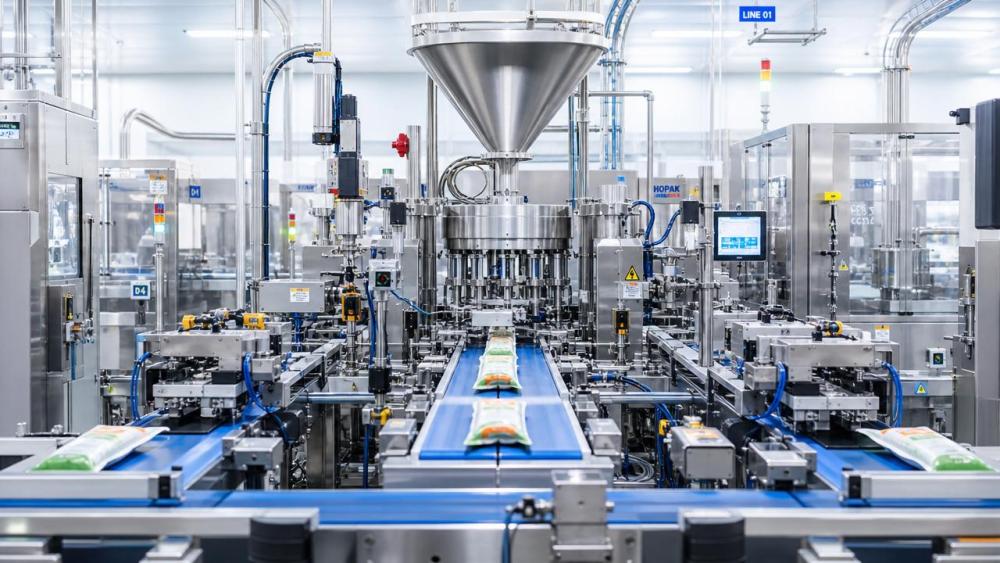
Line changeover time covers more than swapping parts on a machine. It includes product run-down, cleaning and sanitation, format adjustments, recipe loading, sensor calibration, quality verification, label and film replacement, and restart validation. In conventional plants, these steps are often fragmented across operators, paper records, and isolated machines. Smart food manufacturing connects these tasks into one coordinated process.
At its core, smart food manufacturing uses integrated controls, machine data, digital work instructions, AI-supported inspection, and hygienic equipment architecture to reduce manual intervention and uncertainty. Instead of waiting for trial-and-error adjustment, teams can rely on stored recipes, automated change parts recognition, guided cleaning sequences, and real-time line diagnostics. This is especially valuable in food environments where product safety, allergen control, and packaging integrity are non-negotiable.
For sectors covered by AFPS, the impact is broad. Aseptic filling lines need sterile transitions with minimal contamination risk. Dairy homogenization systems must maintain pressure consistency across different formulations. Meat processing lines require strict low-temperature hygiene while switching cuts, marinades, or pack sizes. Baking systems must preserve thermal stability despite product changes. Flexible pouch lines need rapid adaptation across film structures, weights, and seal conditions. In each case, smart food manufacturing turns changeover from a production interruption into a controlled, measurable workflow.
Current Industry Signals Driving Faster, Smarter Changeovers
Food plants are under growing pressure to run smaller batches, launch more variants, and maintain stricter documentation. The result is a sharp rise in the strategic importance of changeover performance. The following signals explain why smart food manufacturing has become central to line design and operational improvement.
These trends show that changeover is no longer just a maintenance or production issue. It sits at the intersection of safety, profitability, energy use, scheduling flexibility, and brand reliability. That is why smart food manufacturing increasingly appears in capital investment discussions as well as continuous improvement programs.
Where the Time Savings Actually Come From
The biggest gains rarely come from one technology alone. They come from removing delay points across the entire transition cycle. In practical terms, smart food manufacturing cuts line changeover time through six repeatable mechanisms.
- Automated recipe and parameter recall: Fill volumes, pressure settings, oven zones, sealing temperatures, and conveyor speeds load automatically instead of being manually entered.
- Tool-less or fast-lock format changes: Packaging lines and portioning systems can switch dimensions faster with fewer adjustment points.
- Smart cleaning sequences: CIP and COP programs verify temperature, conductivity, flow, and time, reducing both under-cleaning and unnecessary over-cleaning.
- Machine vision and sensor verification: Cameras and sensors confirm alignment, seal quality, coding accuracy, and product presence at startup.
- Digital work instructions: Operators follow on-screen tasks in the right order, lowering setup errors and reducing dependency on tribal knowledge.
- Changeover analytics: Timestamped data identifies which step causes the longest delay so improvements target the true bottleneck.
This matters because many plants underestimate hidden losses. A line may appear to be down for 40 minutes, but the actual waste can include 10 extra minutes of waiting for sanitation release, 8 minutes of manual parameter re-entry, or multiple restart checks caused by unstable settings. Smart food manufacturing makes those losses visible and correctable.
Operational Value Across Key Food Processing and Packaging Segments
Different food categories face different constraints, yet the business value of faster changeovers follows a common pattern: more uptime, more schedule agility, less product giveaway, and better control of hygiene risks. The table below shows how smart food manufacturing applies across representative processing environments.
When these benefits are scaled across weeks and months, the commercial effect becomes significant. Faster line changeover supports more campaigns per day, lower overtime, reduced inventory buffering, and better on-time performance. In sectors with strict freshness windows or promotional spikes, smart food manufacturing also helps match output more closely to actual market pull.
Implementation Priorities for Reliable Results
Successful deployment depends on more than adding sensors or software. Plants need a structured approach that connects equipment capability, sanitation strategy, data architecture, and operator usability. The most effective priorities are usually the following:
- Map the full changeover sequence: Break the event into product depletion, cleaning, parts swap, setup, verification, and ramp-up. Measure each stage separately.
- Focus on hygienic design first: Dead-leg reduction, easier access, drainability, cleanable surfaces, and minimized manual touchpoints often unlock the fastest gains.
- Standardize recipes and formats: Too many uncontrolled parameter variations will undermine even advanced automation.
- Link controls and quality data: Startup approval should be based on verified process conditions, not only visual judgment.
- Use dashboards that show delay causes: A simple timestamp view can reveal whether sanitation, mechanical adjustment, or quality release is the main issue.
- Train for exception handling: Even in smart food manufacturing, the real test is how quickly the line recovers when a seal fault, temperature deviation, or vision alarm appears.
One important caution is to avoid treating every line the same. Aseptic systems, for example, demand microbial protection logic that is very different from bakery or meat lines. Likewise, a packaging line may need faster servo format recall, while a liquid process system may benefit more from validated CIP optimization. The right smart food manufacturing roadmap starts with the highest-cost downtime pattern, not with the most fashionable technology.
A Practical Next Step for Smarter Changeovers
A useful starting point is a focused audit of one high-frequency product transition. Track the exact time used for cleaning, component replacement, parameter setup, first-pass quality approval, and stable restart. Then compare that baseline against what could be automated, digitally guided, or redesigned for hygiene and access. In many cases, the first measurable wins come from combining quick-change mechanics with recipe management and sensor-based verification rather than from a full system overhaul.
For organizations following AFPS intelligence across aseptic filling, dairy fluid systems, meat processing, bakery engineering, and flexible packaging, the strategic lesson is clear: smart food manufacturing is not only about advanced equipment. It is about stitching process science, automation logic, and food safety discipline into a faster transition model that protects both throughput and trust. Reducing line changeover time is therefore more than an efficiency project; it is a practical route to stronger resilience in modern food production.
Recommended News